
You press the button, nothing happens. You press it again, still nothing. A garage door remote that stops responding is one of those small problems that quickly turns into a big frustration, especially when you are rushing out in the morning or coming home late at night.
The good news is that most of the time, there is a reason behind it. Understanding what causes a garage door remote to stop working can save you time, stress, and an unnecessary service call. In this guide, we are going to walk through the most common culprits, so you know exactly where to start.
The Battery Is Dead or Weak
This is the most common reason a garage door remote stops responding, and it is also the easiest to overlook. Most homeowners do not think about the battery until the remote completely stops working, but a weak battery can cause inconsistent performance long before it fully dies.
What to Check
- Remove the battery and inspect it for any corrosion or leakage around the contacts.
- If the remote only works when you are standing very close to the garage, a weak battery is likely the cause.
- Replace the battery with a fresh one, typically a 12-volt or 9-volt, depending on your remote model.
- Make it a habit to replace the battery every 12 to 18 months, even if the remote still seems to be working fine.
If you are noticing other warning signs alongside remote failure, reviewing Signs It’s Time to Replace Your Garage Door Remote may help you decide on your next step.
The Remote Is Out of Sync With the Opener
Garage door remotes communicate with the opener through a frequency signal. Over time, that signal can fall out of sync, especially after a power outage, a new opener installation, or accidentally holding down the remote button for too long.
What to Check
- Check if other remotes or the wall keypad still work. If they do, the problem is isolated to your handheld remote.
- Most openers have a “Learn” button on the motor unit that allows you to re-pair the remote. Check your opener’s manual for the exact steps.
- If you recently had a power surge or the opener was reset, all previously paired remotes will need to be re-synced.
Signal Interference Is Blocking the Remote
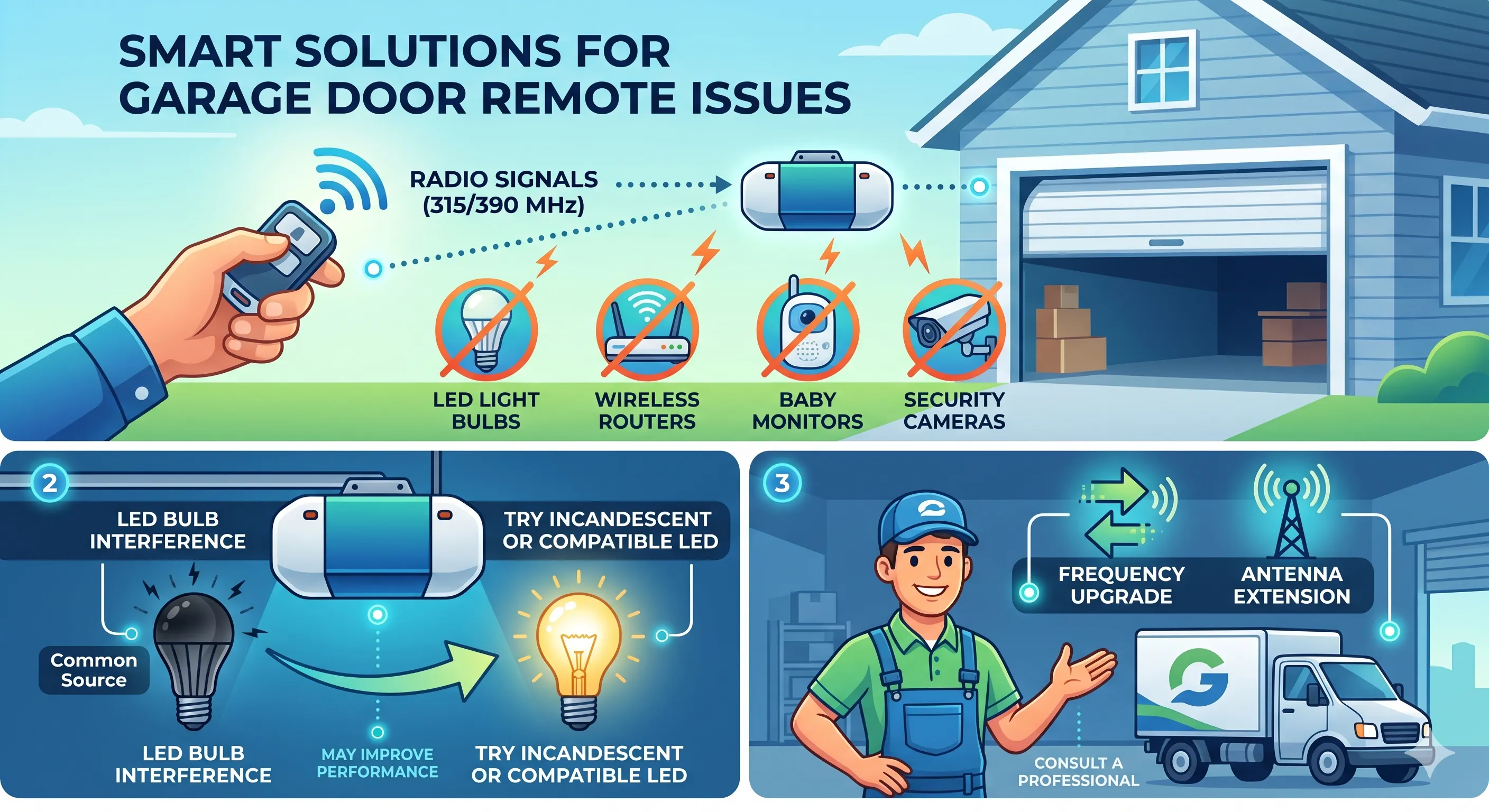
Your garage door remote operates on a radio frequency, typically around 315 MHz or 390 MHz. Several common household devices and environmental factors can interfere with that signal and prevent it from reaching the opener.
What to Check
- LED light bulbs installed in the garage opener itself are a surprisingly common source of interference. Certain LED bulbs emit radio frequency noise that disrupts the remote signal.
- Nearby electronics such as wireless routers, baby monitors, and security cameras can also cause interference.
- Try replacing the LED bulb in your opener with an incandescent bulb or an opener-compatible LED bulb to see if performance improves.
- If interference is a recurring issue, a professional technician can assess whether a frequency upgrade or antenna extension is needed.
The Antenna on the Opener Is Damaged or Misaligned
The motor unit on your garage door opener has a small antenna that receives the signal from your remote. If that antenna is bent, damaged, or positioned incorrectly, it will struggle to pick up the signal, causing the remote to appear unresponsive.
What to Check
- Locate the antenna wire hanging from the motor unit. It should hang straight down and be free of any obstructions.
- Inspect the antenna for any visible damage, kinks, or fraying.
- Gently straighten the antenna wire if it has been bent or coiled. This simple adjustment can dramatically improve signal reception.
- Make sure no shelving, storage boxes, or equipment is blocking the antenna’s line of sight toward the door entrance.
- If the antenna wire is physically damaged, a garage door professional should replace it to avoid further opener issues.
If the antenna is damaged beyond repair, it’s best to contact a garage door opener repair professional for replacement. Addressing the issue early can help prevent further problems with your opener system.
For homeowners who want to understand how opener components like the antenna and receiving board are expected to function, the DASMA garage door opener safety guidelines are a reliable and authoritative reference.
The Remote Has Physical Damage
Remotes take a beating over time. They get dropped, left in hot cars, sat on, and soaked in rain. Physical damage is a common reason remotes stop working, and it is not always obvious from the outside.
What to Check
- Open the remote casing and inspect the circuit board for any visible damage, burned areas, or loose components.
- Look for any signs of water damage, which often appears as white residue or corrosion on the internal components.
- If the remote casing is cracked or the buttons feel unresponsive, it is likely time to replace the unit entirely.
- For remotes that got wet, remove the battery immediately and allow it to dry fully before testing again.
If the remote damage is accompanied by other unusual behaviors from the door or opener, this guide to troubleshooting common garage door problems covers a wide range of issues that often develop alongside remote failure.
The Opener’s Receiving Board Has a Problem
Sometimes the issue is not with the remote at all but with the opener itself. The logic board or receiving circuit inside the motor unit can wear out, get damaged by power surges, or simply fail over time.
What to Know
- If no remotes work, including ones that were previously synced, and the wall-mounted button still operates the door, the receiving board may be the issue.
- A power surge, especially common during Oklahoma City’s spring storm season, can damage the receiving board without leaving visible signs.
- Receiving board issues should be handled by a qualified garage door technician, as they involve internal electrical components.
- If your opener is more than 10 to 15 years old and the receiving board has failed, a full opener replacement may be the smarter investment.
The Safety Sensors Are Misaligned or Obstructed
While safety sensors are primarily responsible for stopping the door from closing on an obstruction, a sensor fault can sometimes affect overall system communication and make the remote appear unresponsive.
What to Check
- Locate the two small sensors near the base of your garage door tracks, one on each side.
- Check whether the indicator lights on both sensors are solid. A blinking or off light typically signals a misalignment or obstruction.
- Gently wipe the sensor lenses with a clean, dry cloth and carefully realign them so they face each other directly.
- Avoid placing boxes, tools, or any equipment near the sensor path, which is a common issue in busy garages.
If the sensors still aren’t functioning properly after cleaning and realignment, it may be time to call a garage door repair professional to inspect and resolve the issue safely.
The Wall Button Works but the Remote Does Not
This is one of the most telling signs in garage door remote diagnostics. If the wall-mounted button operates the door without any issue but your remote does not, the problem is definitely with the remote or its communication with the opener, not the opener itself.
What This Tells You
- This confirms the opener motor and mechanism are functioning correctly.
- The issue is isolated to the remote’s battery, its programming, its internal components, or a signal interference problem.
- Work through the earlier causes in this list, starting with the battery and re-syncing steps.
- If you have a spare remote, test that one to determine if the issue is specific to one unit or a broader communication problem.
Learning how to properly care for your remote from the start can prevent many of these issues. Our guide on Garage Door Remote Maintenance Tips to Avoid Issues covers the key habits every homeowner should know.
Extreme Temperatures Are Affecting Performance
Oklahoma City homeowners know firsthand that temperatures can swing dramatically throughout the year. Extreme heat in summer and sharp cold in winter can both affect how your garage door remote performs.
What to Check
- Cold temperatures can reduce battery efficiency significantly, causing a remote that worked fine indoors to perform poorly outside.
- Excessive heat, especially in a vehicle during Oklahoma summers, can warp plastic components inside the remote or degrade the battery faster.
- In colder months, warm the remote in your hands for a moment before use to improve battery conductivity.
- Avoid leaving your remote on a car dashboard during summer. Store it in a cooler area such as the center console or glove box.
The Remote Needs to Be Replaced Entirely
There comes a point where continued troubleshooting stops making sense and replacement is simply the smarter choice. Remotes are not designed to last forever, and an aging unit will become increasingly unreliable regardless of how well it has been maintained.
Signs the Remote Is at the End of Its Life
- The remote has been dropped, damaged, or exposed to water multiple times.
- Replacing the battery no longer improves performance.
- The remote works only sporadically or at very close range even after re-syncing.
- The remote model is no longer supported or compatible with an upgraded opener.
- Replacement remotes are available through your opener’s manufacturer or a licensed garage door professional. Average costs vary depending on your opener brand and model.
For a full breakdown of warning signs, check out How to Troubleshoot a Garage Door Remote at Home to understand what steps to take before committing to a replacement.
When to Call a Professional in Oklahoma City
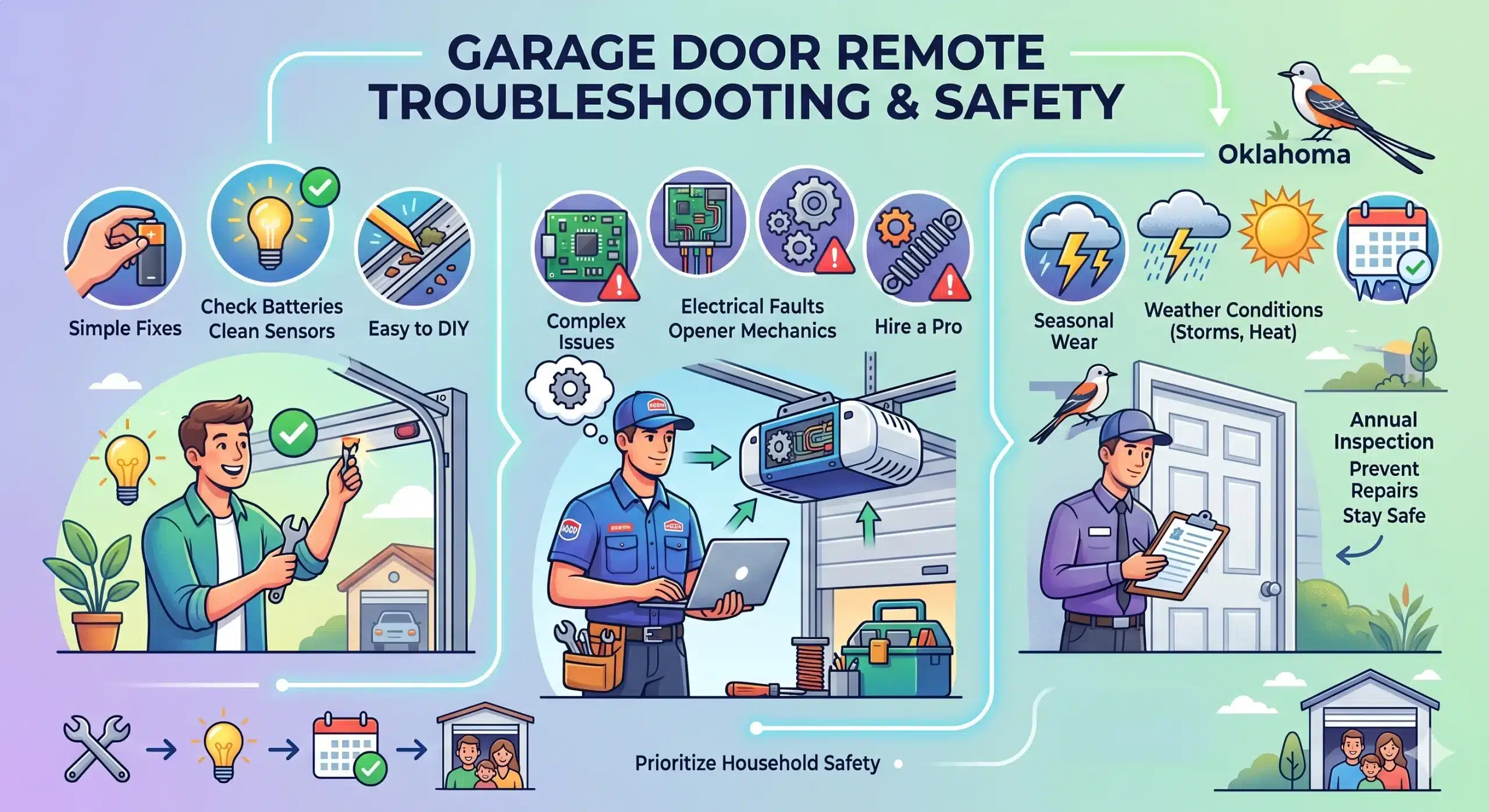
Some of the causes listed above are straightforward enough for most homeowners to address on their own. Others, however, involve electrical components, opener mechanics, or safety systems that are best left to a trained technician.
- If you have worked through the most common causes and the remote still is not responding, it is time to bring in a professional.
- If you suspect the issue involves the opener’s logic board, antenna wiring, or safety sensor system, do not attempt to address it on your own.
- Attempting to repair internal opener components without the proper training can lead to further damage or create a safety risk for your household.
- Oklahoma City homeowners should keep in mind that seasonal weather conditions, from severe spring storms to intense summer heat, can accelerate wear on garage door systems.
- Scheduling a professional inspection once a year is one of the best ways to catch small issues before they become costly problems.
Don’t Let a Small Problem Turn Into a Bigger One
A garage door remote that stops working is rarely a sign of a serious mechanical failure, but it should not be ignored for too long either. Left unaddressed, a communication or power issue with the remote can sometimes mask deeper problems with the opener that are developing in the background. Taking a few minutes to work through the possible causes in this guide can help you identify the problem quickly and decide whether it is something you can handle yourself or something that needs a professional eye.
When you are ready for expert guidance from a team that knows Oklahoma City garage doors inside and out, CCM Overhead Doors is here to help. Whether you have questions about your remote, your opener, or the overall condition of your system, our technicians are ready to walk you through your options. Contact us or give us a call today to schedule a service visit.